The Drainage Problem That's Ageing Your Roof Faster Than the Weather Is
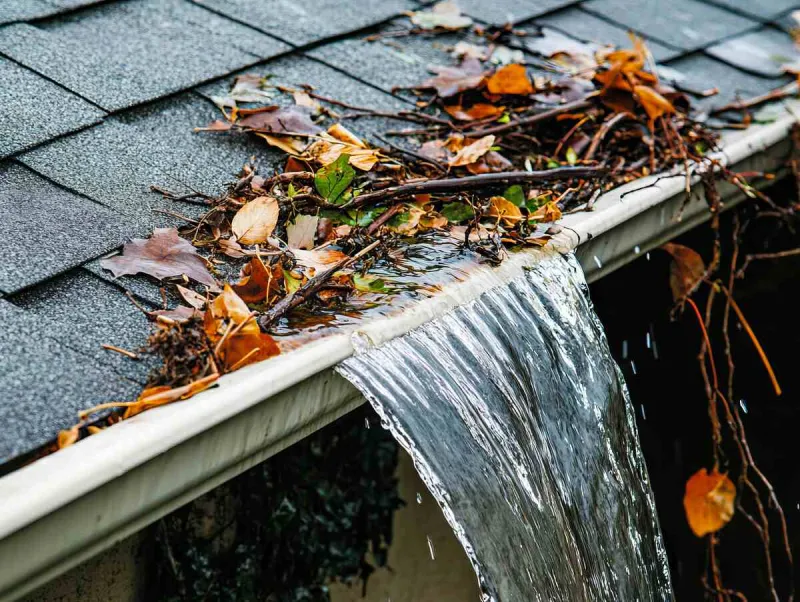
Photo: clogged residential gutters overflowing with water during rain Ontario Canada, via dampsurveyorsltd.com
If you asked most St. Catharines homeowners to identify the greatest threat to their roof, the answers would cluster predictably: heavy snowfall, ice dams, last autumn's windstorm. Gutters would rarely make the list. Yet in the course of roof assessments across the Niagara Region, drainage failures consistently rank among the primary contributors to premature roof deterioration — not because the problem is dramatic, but because it is relentlessly incremental.
Water does not announce itself when it begins doing damage. It seeps, saturates, and retreats, leaving behind evidence that only becomes legible months or years later, when repair costs have grown considerably.
Why Niagara's Precipitation Patterns Make Gutters Non-Negotiable
St. Catharines receives roughly 900 millimetres of precipitation annually, a figure that places it among the wetter urban centres in Ontario. That number, however, does not capture the full picture. The Niagara Region's proximity to the Great Lakes introduces intense, localised precipitation events — concentrated rainfall that can deposit significant volumes of water in short periods. Add the snowmelt of a typical Niagara spring, and the cumulative hydraulic demand placed on a residential drainage system becomes substantial.
A functional gutter system is designed to collect that water at the roofline and channel it away from the building's foundation and cladding. When that system is partially or fully obstructed — by leaf debris, granule accumulation from ageing shingles, or structural sagging — water does not simply stop. It redirects. And the places it redirects to are precisely the places most vulnerable to moisture intrusion.
How Gutter Failures Translate Into Roof Damage
The connection between gutters and roof deterioration is not always obvious because the damage mechanism operates behind the scenes. Understanding it requires tracing the path water takes when drainage fails.
Fascia and soffit saturation: When gutters overflow or pull away from the fascia board due to weight and debris accumulation, water runs directly down the vertical face of the roofline. Fascia boards are typically made of wood or engineered wood composites — materials that absorb moisture readily. Once saturated, they begin to rot, and as they do, the structural attachment point for the gutter system weakens further, compounding the problem.
Roof deck intrusion at the eaves: Standing water in a blocked gutter sits in direct contact with the lowest course of shingles and the roofing underlayment beneath them. Over repeated wetting and drying cycles, this contact degrades the adhesive strip on shingles, lifts edges, and allows moisture to wick beneath the surface. In winter, that same standing water freezes and expands, forcing its way under shingles in a process that closely mimics — and often initiates — ice dam formation.
Attic moisture and structural compromise: When water infiltrates beneath the eave shingles and saturates the roof deck, it does not stop at the wood surface. It migrates inward, introducing moisture to the attic space. Over time, this contributes to elevated humidity levels, mould growth on rafters and sheathing, and the gradual degradation of insulation performance — all of which affect the long-term structural integrity of the roof assembly.
Foundation and grading consequences: While this falls outside the roof itself, gutters that discharge water improperly — or not at all — deposit large volumes of water directly against the home's foundation. This affects the soil grading around the building, which can in turn cause ground-level water to migrate toward the structure rather than away from it.
A Practical Diagnostic Guide for St. Catharines Homeowners
You do not need to climb onto your roof to identify whether your drainage system is contributing to deterioration. The following observations can be made from ground level or from inside the attic.
During or immediately after rainfall:
- Water cascading over the front edge of gutters rather than exiting through downspouts indicates a blockage or inadequate slope.
- Waterfall-style overflow at the corners of the guttering suggests the downspout connection is obstructed.
- Water staining or green algae growth on exterior cladding below the gutterline points to chronic overflow.
Along the roofline and eaves:
- Visible sagging or separation of gutters from the fascia board suggests accumulated weight from debris and standing water.
- Paint peeling or discolouration on fascia boards is a reliable indicator of prolonged moisture exposure.
- Granule deposits inside gutters are normal to a degree, but heavy accumulation may indicate accelerated shingle wear that is itself being exacerbated by drainage issues.
Inside the attic:
- Dark staining or soft spots on the underside of the roof deck near the eaves indicate water infiltration from below the shingle line.
- A persistent musty odour during or after rain warrants investigation, as it often precedes visible mould development.
Addressing Drainage Before Addressing the Roof
There is a sequencing logic to roof maintenance that is frequently overlooked: repairing or replacing a roof without first correcting the drainage conditions that damaged it is an exercise in diminishing returns. New shingles installed over a compromised fascia, or above a drainage system that will continue to overflow, are subject to the same deterioration pathways from the moment they are laid.
For this reason, St. Catharines Roofing Pros consistently recommends that homeowners treat gutter inspection and maintenance as a prerequisite to any significant roofing work — not an afterthought. In many cases, correcting drainage issues alone extends the serviceable life of an otherwise sound roof by several years, deferring far more expensive interventions.
Practical steps that make a measurable difference include:
- Annual cleaning: Gutters in the Niagara Region should be cleared of debris at minimum twice per year — once in late autumn after leaf fall, and once in early spring following snowmelt.
- Slope verification: Gutters require a consistent downward slope toward downspouts of approximately 6 millimetres per 3 metres of run. Improper slope allows water to pool.
- Downspout extension: Downspouts should discharge water at least 1.5 to 2 metres from the building's foundation. Extensions are inexpensive and highly effective.
- Gutter guard evaluation: In areas with significant tree coverage, gutter guards can reduce maintenance frequency, though they require their own periodic inspection to remain effective.
The Investment Perspective
Gutter maintenance is among the lowest-cost, highest-return activities available to a homeowner concerned with preserving their roofing investment. A professional gutter cleaning in St. Catharines costs a fraction of what even a minor roof repair requires — and a fraction of a fraction of what partial roof deck replacement entails.
The arithmetic is straightforward. The challenge is that gutter neglect does not announce itself with urgency. It accumulates quietly, across seasons, until the consequences become visible in the form of stained ceilings, rotted fascia, or a roofing contractor pointing to water-damaged decking during an inspection.
At St. Catharines Roofing Pros, we assess the complete drainage context of every roofing system we inspect. Because a roof is only as durable as the conditions surrounding it — and in Niagara, those conditions begin with where the water goes.