After the Storm Passes: Why Niagara's Worst Roof Damage Begins the Morning After
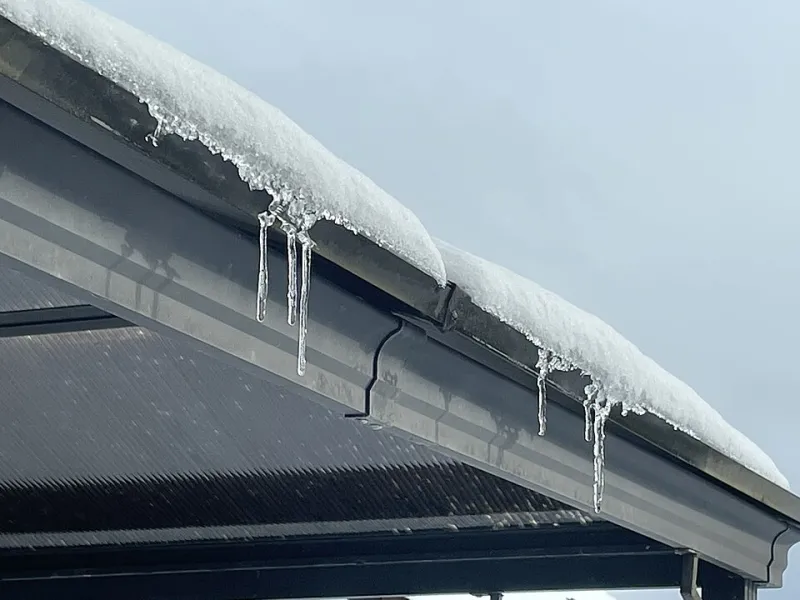
Photo: Marius Vassnes, CC BY-SA 4.0, via Wikimedia Commons
The snowband that rolled off Lake Ontario overnight has moved east, the driveway is cleared, and by ten in the morning the sun is out over St. Catharines. As far as most homeowners are concerned, the storm is finished. On the roof, it has only just begun.
Ice dams are seldom built during a snowstorm. They are built in the twelve to thirty-six hours that follow, when a bright, cold afternoon melts snow on the upper slope and sends that water down to an eave that is still far below freezing. What forms there is a ridge of ice at the gutter line, a shallow pond behind it, and water hunting for the nearest way in — under the shingles, along the deck boards, and into the wall assembly above a window frame.
The mechanism, stripped of jargon
An ice dam needs three conditions at once: snow on the roof, an eave that stays below zero, and a stretch of roof deck above zero. The first two are supplied by the weather. The third is supplied by the house.
Warm air escaping from the living space — through recessed light fixtures, an unsealed attic hatch, a plumbing stack, or the top plates of interior walls — raises the temperature of the attic and, in turn, of the roof deck above it. Snow melts over the warm middle of the roof and runs downhill as liquid water. By the time it reaches the overhang, which sits beyond the insulated envelope and stays at ambient temperature, it freezes. Repeat that cycle across a few days and the ice crest grows until it is tall enough to back water up beneath the courses above it.
The principle contractors repeat is that a roof should be cold on both sides: cold above from snow cover, cold below from an airtight, well-insulated ceiling. When a roof leaks in winter, the fault is usually in the ceiling plane rather than in the shingles.
Why Niagara's climate is unusually good at manufacturing them
A sustained cold snap of minus twenty is, counter-intuitively, the safer scenario. Nothing melts, so nothing refreezes. Niagara's winters do the opposite: the mercury drifts above and below zero repeatedly, and every crossing of that line is another melt-and-freeze event.
Add lake-effect snow. Bands off Lake Ontario can drop fifteen or twenty centimetres on one part of the city while another sits in sunshine, and that fresh depth insulates the deck, traps whatever heat is escaping, and slows the drainage of meltwater. St. Catharines also occupies the moderating band between the lake and the escarpment, which is precisely the setting that produces repeated freeze-thaw rather than a clean, deep freeze.
The north slope, and the more reliable predictor
North-facing slopes are usually the first to show trouble. They receive the least winter sun, they hold snow longer, and whatever melt does occur is slower and more prone to refreezing overnight. They are also the slope a homeowner is least likely to see from the driveway.
Compass direction is only half the explanation, however. The more dependable indicator is what lies beneath a given slope. A north slope over a cold bedroom and a well-sealed attic may never build a dam; a south slope over a heated kitchen with a cathedral ceiling and two badly placed pot lights may build one every February. In practice, the slopes that dam are the slopes above the warmest rooms and the leakiest ceilings.
Four signs that deserve a phone call
A continuous curtain of icicles along the gutter line. A few thin icicles after a thaw are ordinary. A solid, heavy fringe that persists for days, particularly one that appears after a mild afternoon, is the visible edge of a dam.
Staining or bubbling paint on the soffit and fascia. Water backing up at the eave has to go somewhere. Dark streaks, a swollen fascia board, or paint lifting on the soffit are evidence that it is travelling through the roof-edge assembly.
Water at the top of a window frame, or a damp patch near an exterior wall. This is the classic interior symptom, and it is easily dismissed as condensation. Condensation appears on glass; a leak appears at the head of the frame and along the wall-to-ceiling joint.
Frost or daylight in the attic. Frost on the underside of the roof deck, or on a north gable, is warm moist air condensing where it should never have arrived.
What a homeowner can reasonably do in 2026 without a ladder
Ladder work in February is among the leading causes of serious household injury, and a fall from a two-storey eave is not a maintenance chore. The realistic options are limited, but they are genuinely useful.
- Inspect from the ground with binoculars or a phone camera. Zoom in on the eave line, the valleys, and the chimney flashing. Take dated photographs; insurers and contractors both value them.
- Use a roof rake only where it can be used safely. That means a single-storey reach, standing on the ground, pulling snow — never pushing, never on a metal roof, and never within reach of overhead service lines. On a two-storey home there is no safe rake; leave it alone.
- Never chip ice and never apply salt. Both strip shingle granules, void material warranties, and address nothing.
- Keep the attic hatch closed and sealed. Opening it to air out the attic admits warm, moist air precisely where it does the most harm.
- Document and contain. Shift stored items away from any damp spot, photograph the staining, and record the date. If water is actively entering, call a roofing contractor rather than waiting for spring.
Treating the cause, not the crest
Icicle removal and heat cable are symptom management. The durable fixes sit in the attic, and they are best carried out in the shoulder season rather than in January.
Air sealing comes first. Insulation slows heat loss; air sealing stops it. In Niagara homes the usual suspects are the attic hatch, recessed fixtures, bathroom fans discharging into the attic instead of outdoors, plumbing stacks, and the gaps where interior wall top plates meet the ceiling.
Insulation second. Current Ontario energy requirements for ceilings land in the R-50 to R-60 range, and many older St. Catharines attics carry less than half that. Topping up is straightforward, but doing so without air sealing first is largely wasted effort.
Ventilation third. Intake at the soffit, exhaust at the ridge or through box vents, and — critically — baffles that keep blown insulation clear of the soffit path. An attic that cannot breathe will hold moisture even when it is cold.
Membrane as a backstop. A self-adhering ice-and-water shield along the eaves gives the assembly a second line of defence if a dam does form. It is installed during a roof replacement rather than retrofitted, which is one reason to raise the question before the next re-roof rather than after it.
The myth, restated
The snowstorm receives the attention because it is visible. The damage happens quietly the following morning, in clear weather, while water is running downhill and the eave is turning it back. Nobody stops an ice dam from a ladder in February. It is stopped in September, in the attic, with a tube of sealant and a few extra bags of insulation.