The Five Weakest Points on Your Roof: Where Niagara Homes Actually Leak First
When homeowners in St. Catharines call us about a leak, the first thing they usually say is that their shingles must be failing. In reality, the shingles are rarely the culprit. Water almost always finds its way in at the transitions — where the roof meets a wall, where a vent pipe punches through the deck, where two slopes collide. These are the components that fail first in Niagara's climate, and knowing how to spot trouble at each one can save you thousands of dollars.
Why the Edges Fail Before the Field
Niagara's weather is uniquely punishing on roof components. Our proximity to Lake Ontario and the Niagara Escarpment produces frequent freeze-thaw cycles through late fall and early spring, when temperatures swing above and below zero within a single day. Any gap — even one the width of a fingernail — opens and closes with each cycle, working sealants loose and lifting metal edges.
Add in lake-effect snow, wind-driven rain off the lake, and the occasional summer hailstorm, and you have a climate that attacks joints and penetrations long before it wears out the field of shingles. Below are the five components we replace most often on St. Catharines homes, along with realistic repair costs and the warning signs worth knowing.
1. Flashing at Chimneys and Walls
Flashing — the thin metal that seals the junction where your roof meets a chimney, dormer, or siding — is the single most common failure point we see across Niagara Region homes. Step flashing and counterflashing rely on precise overlaps, and over time the fasteners corrode, the sealant dries out, and the metal itself can pull away from masonry.
Warning signs: Rust streaks on the chimney, water stains on ceilings near a fireplace, or visible gaps where flashing has separated from brick.
Typical repair cost: $300–$800 for a localized section; $1,000–$2,500 for full chimney reflashing, depending on the masonry condition and roof height.
2. Pipe Boots and Vent Collars
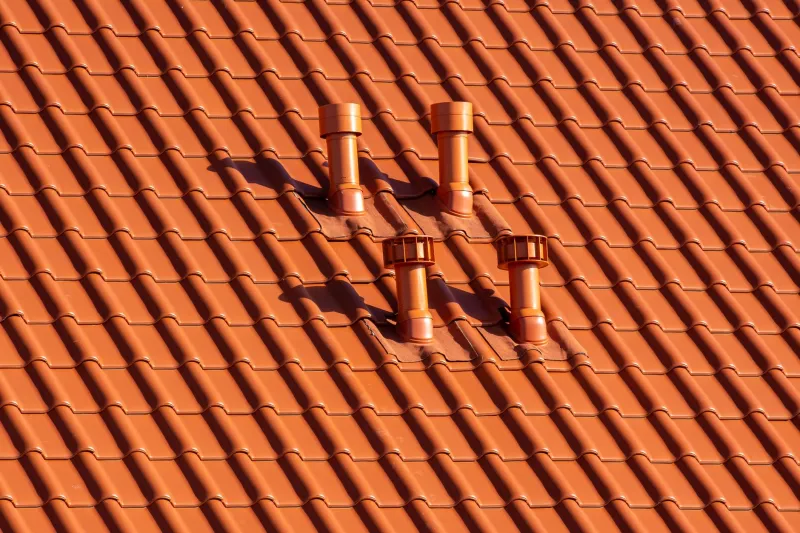
Every plumbing vent and exhaust pipe penetrating your roof passes through a rubber collar called a pipe boot. That rubber is the most fragile material on your entire roof — typically rated for 10 to 15 years, far less than the 20 to 25 years of the asphalt shingles around it. UV exposure and our harsh freeze-thaw swings crack the rubber long before the roof itself is done.
Warning signs: Split or sun-bleached rubber visible from the ground with binoculars, or unexplained attic moisture directly beneath a vent pipe.
Typical repair cost: $150–$400 per boot, including shingle re-sealing.
3. Roof Valleys
A valley is where two roof slopes meet and channel a concentrated stream of water downward. During a heavy Niagara rainstorm or a rapid spring snowmelt, a valley handles more water volume per square metre than any other part of your roof. Improperly installed valley metal, debris accumulation, or shingle erosion in the channel can let water migrate under the shingles and into the deck.
Warning signs: Granule buildup in gutters, visible rust or cracks along the valley line, or interior staining that follows the valley's path on the ceiling below.
Typical repair cost: $400–$1,200 for a valley section replacement; more if the underlying decking has rotted.
4. Eavestroughs and Drip Edge
Though technically part of the drainage system rather than the roof covering, eavestroughs and drip edge protect the most vulnerable edge of your roof. When gutters clog with maple keys and spring debris — a familiar sight under the mature trees in neighbourhoods like Grantham and Western Hill — water backs up under the shingles and rots the fascia. Missing or bent drip edge lets the same water wick into the roof deck itself.
Warning signs: Water spilling over gutter edges during rain, peeling paint on the fascia board, or ice buildup along the eaves in January.
Typical repair cost: $200–$600 for drip edge replacement along one side of a home; full eavestrough replacement runs $1,200–$2,500 on an average St. Catharines bungalow.
5. Skylight Seals and Curbs
Skylights brighten a home beautifully, but each one introduces a perimeter of flashing, sealant, and curb construction — four corners where water can enter. Manufacturers typically rate skylight seals for 10 to 20 years, and older units installed in the 1990s and early 2000s are now well past their service life in thousands of Niagara homes.
Warning signs: Condensation between the glass panes, water staining on the drywall around the skylight well, or cracked perimeter sealant visible from the roof.
Typical repair cost: $300–$700 to reseal and reflashing; $900–$2,500 for full skylight replacement.
A Simple Post-Storm Walkaround
After any significant windstorm or heavy rain, you can do a meaningful check from the safety of the ground:
- Walk the perimeter and scan the roofline for lifted flashing or bent vent pipes.
- Check the ground beneath eaves for unusually heavy granule loss.
- Look in the attic with a flashlight after the next rainfall, focusing on the underside of penetrations.
- Note any new ceiling stains, even faint ones, and photograph them for comparison.
Never climb a ladder to inspect damage — wet or icy surfaces make roof access genuinely dangerous, and a ground-level or attic check will reveal most developing problems.
Catch It Early, Pay Less
The pattern across all five components is the same: the failure itself is inexpensive to fix, but the water damage it causes is not. A $250 pipe boot repair, deferred for two seasons, can turn into a $2,000 deck and insulation rebuild. If you've spotted any of the warning signs above — or simply aren't sure what condition your roof's edges are in — a professional inspection will map every penetration, valley, and flashing run on your home. For St. Catharines homeowners, that small investment is the most reliable way to keep a minor component failure from becoming a major renovation.