Why Two Identical Roofs in St. Catharines Can Age Decades Apart

Photo by Photo by Dillon Kydd on Unsplash on Unsplash
Imagine two houses on the same street in St. Catharines. Both were built in the same year, both received new roofs from the same manufacturer's product line, and both carry a 25-year warranty. Twenty years later, one roof is performing flawlessly. The other is already showing signs of advanced deterioration and will need full replacement within two to three years.
This scenario is not hypothetical. It plays out regularly across the Niagara Region, and it frustrates homeowners who assumed that a warranty was a reliable predictor of lifespan. The truth is considerably more nuanced — and considerably more useful once you understand it.
What a Warranty Actually Promises
Manufacturer warranties on roofing products are widely misunderstood. A 25-year or 30-year warranty does not guarantee that your roof will last that long under real-world conditions. What it guarantees, in most cases, is that the product will not fail due to a manufacturing defect within that period — and even that protection is subject to conditions that many homeowners never read carefully.
Most residential roofing warranties in Canada contain clauses that void coverage if the product was not installed according to the manufacturer's specifications, if ventilation requirements were not met, if the roof was subjected to physical damage, or if maintenance was neglected. In practice, these exclusions are broad enough that legitimate warranty claims are far less common than homeowners expect.
The warranty, in other words, reflects the potential of the material under controlled conditions. It says very little about how that material will perform on your specific roof, in your specific location, maintained at whatever level of regularity you choose.
The Installation Variable: Where Lifespan Is Won or Lost
Of all the factors that determine a roof's actual lifespan, installation quality is arguably the most consequential — and the least visible to the homeowner at the time it matters most.
A properly installed asphalt shingle roof in the Niagara Region, under average conditions, can reasonably be expected to perform for 20 to 25 years. An improperly installed roof using the identical shingle product may begin failing within 10 to 12 years. The difference lies in details that are invisible once the job is complete: nail placement, nail depth, starter strip installation, underlayment overlap, flashing integration, and ridge cap fastening.
Nailing is a particularly instructive example. Shingles must be fastened within a specific nailing zone defined by the manufacturer. Nails placed too high on the shingle — a common shortcut under time pressure — reduce the shingle's wind resistance dramatically. In a region like Niagara, where lake-effect wind events are a regular occurrence, high-nailed shingles can begin lifting and losing seal within a few years of installation.
Underlayment installation is equally critical. The synthetic or felt underlayment beneath the shingles serves as a secondary water barrier. Improper lapping at seams or inadequate fastening allows wind-driven rain to penetrate the underlayment layer, placing the roof deck in direct contact with moisture.
The practical implication for homeowners is clear: the contractor you choose matters more than the product you choose. A premium shingle installed carelessly will underperform a standard shingle installed correctly.
How Niagara's Climate Stress-Tests Every Roof
The Niagara Region imposes a demanding set of environmental conditions that accelerate wear on all roofing materials. Understanding these stressors helps explain why roofs in St. Catharines age differently than the same products might in, say, Calgary or Ottawa.
Freeze-thaw cycling is among the most mechanically destructive forces a roof can experience. Niagara winters are characterized not by sustained deep cold, but by repeated transitions above and below freezing. Water that infiltrates even minor imperfections in shingles or sealants expands upon freezing, widening those imperfections with each cycle. A roof in this region may experience dozens of freeze-thaw cycles in a single winter.
Humidity and moisture exposure are elevated year-round due to the region's proximity to Lakes Erie and Ontario. Persistent dampness degrades asphalt binders, promotes biological growth, and accelerates the deterioration of wood components beneath the roofing surface.
Wind exposure along the escarpment and lake plain is significant. Areas of St. Catharines closer to the lake or the Niagara Escarpment experience higher average wind speeds than sheltered inland locations. Wind uplift is a primary cause of shingle loss and flashing displacement.
UV radiation during Niagara's warm, sunny summers accelerates the oxidation of asphalt, causing shingles to become brittle and lose granule adhesion more rapidly.
A roof's effective lifespan in this environment is always shorter than the same product's rated lifespan under laboratory or temperate-climate conditions.
Comparative Lifespans by Material: Realistic Niagara Estimates
The following estimates reflect realistic performance expectations for roofing materials installed correctly in the Niagara Region, accounting for local climate conditions:
Standard 3-tab asphalt shingles: 15 to 20 years. This product has largely fallen out of favour among contractors and homeowners who prioritize longevity, as its thinner profile offers less resistance to wind and impact damage.
Architectural (laminate) asphalt shingles: 20 to 28 years. The most common choice for residential roofing in St. Catharines, architectural shingles offer substantially better performance than 3-tab products due to their multi-layer construction and improved wind resistance ratings.
Impact-resistant architectural shingles: 25 to 33 years. Designed to withstand hail and debris impact, these products also demonstrate improved resistance to the thermal cycling that degrades standard shingles in Niagara's climate.
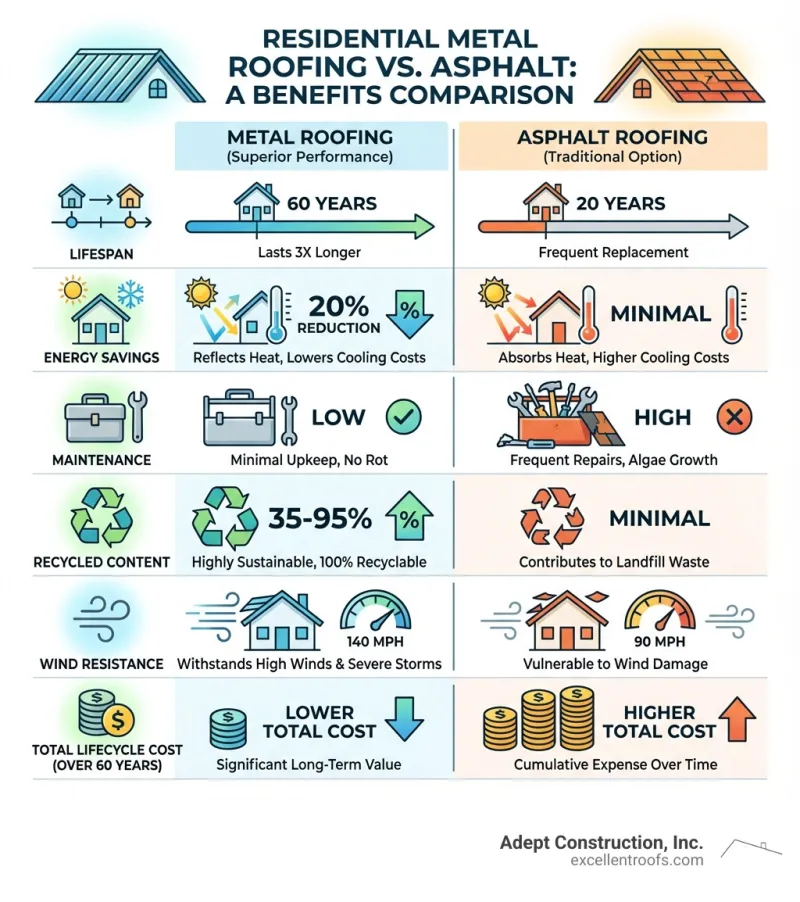
Metal roofing (standing seam or steel panel): 40 to 60 years. Metal roofs outperform all asphalt products in longevity, though their higher upfront cost requires a longer ownership horizon to justify on a purely financial basis. They are, however, exceptionally well-suited to Niagara's moisture and freeze-thaw environment.
Cedar shake: 20 to 30 years with diligent maintenance, but significantly less in high-humidity environments without proper treatment. Cedar is less common on new installations in the region due to its maintenance demands and fire rating considerations.
Flat/low-slope roofing (TPO, EPDM, modified bitumen): 15 to 25 years depending on membrane type and installation quality. Flat roofs are particularly vulnerable to ponding water and require more frequent inspection in this region.
The Maintenance Multiplier
Perhaps the most underappreciated variable in the roof lifespan equation is maintenance — or the absence of it. A well-maintained roof does not simply last longer in an abstract sense; maintenance actively interrupts the deterioration cycles that would otherwise compound unchecked.
Consider a minor flashing separation at a chimney base. Left unaddressed, water infiltrates the roof deck with every rainfall. Within one to two seasons, the deck beneath the flashing begins to rot. Within three to four seasons, the rot has spread to adjacent framing members. What began as a repair that might have cost a few hundred dollars has escalated into a project costing several thousand.
Homeowners who schedule annual inspections — ideally in spring after the winter stress period and in autumn before freeze-up — consistently extend the functional lifespan of their roofs by catching these small failures before they propagate. In the Niagara Region, where climate stressors are elevated, annual professional inspection is not a luxury; it is a cost-effective maintenance strategy.
Location Within the Region Also Matters
Not all parts of the Niagara Region are climatically identical. Homes closer to the lake shore experience higher humidity and wind exposure than those further inland. Properties along the Niagara Escarpment may face different drainage and moisture retention patterns. Even within St. Catharines, a home in a heavily treed neighbourhood will accumulate organic debris and retain moisture differently than a home on an open lot.
These micro-level variables contribute to the roof lifespan differences that neighbours often notice and struggle to explain. The answer is rarely the product — it is almost always the combination of installation quality, maintenance history, and site-specific environmental exposure.
Making an Informed Decision
Armed with this understanding, homeowners in St. Catharines are better positioned to make roofing decisions that reflect their actual circumstances rather than marketing claims. Choosing a reputable, experienced local contractor is the single highest-leverage decision in the process. Selecting a material appropriate to the region's climate demands — and budgeting for the maintenance it requires — is the logical next step.
At St. Catharines Roofing Pros, we provide honest assessments of roof condition and realistic lifespan projections based on the specific characteristics of each property we inspect. A roof's story is written not just in the product installed on it, but in every season it has weathered and every repair that was — or was not — made along the way.