From Phone Call to Final Report: Inside a Professional Roof Assessment on a St. Catharines Bungalow
For many homeowners, the hardest part of arranging a roof inspection isn't the cost — most reputable St. Catharines contractors offer assessments at no charge. It's the uncertainty. What will the roofer actually do up there? What questions should you expect? And how can you tell a thorough professional from someone angling for a quick sale?
To remove the mystery, we've mapped out a complete assessment from first contact to final documentation, using a hypothetical 1960s bungalow near Ridley College as our example. If you know what a proper inspection looks like, you're far better positioned to judge the company performing one.
The First Phone Call: More Than Scheduling
A quality assessment begins before anyone sets foot on your property. Expect the person taking your call to ask substantive questions: the approximate age of the roof, whether you've noticed water staining on ceilings, how the attic smells and feels, and whether any recent storms or ice events have affected the neighbourhood.
These aren't small talk. A roof on a bungalow near the Welland Canal corridor faces different wind exposure than one tucked into the orchard country above the Escarpment, and a leak history helps the inspector arrive with the right tools and priorities. If the caller takes no notes and asks nothing beyond your address, treat that as an early signal.
Arrival and the Exterior Walk-Around
Professional assessments almost always begin at ground level — not on the ladder. The inspector circles the home, examining:
- Gutter lines and downspouts, checking for sagging, granule accumulation, and staining on fascia boards
- Soffits and eaves, where ventilation intake and early rot typically reveal themselves
- Roof planes visible from the yard, looking for lifted shingles, uneven sag lines, or displaced flashing
- Ground conditions, since grading and downspout discharge affect how much water the roof drainage system must handle
On our hypothetical bungalow, an inspector might note moss colonization on the north-facing slope — common on tree-lined St. Catharines streets where shade lingers well into the afternoon.
On the Roof: Tools, Tests, and Technique
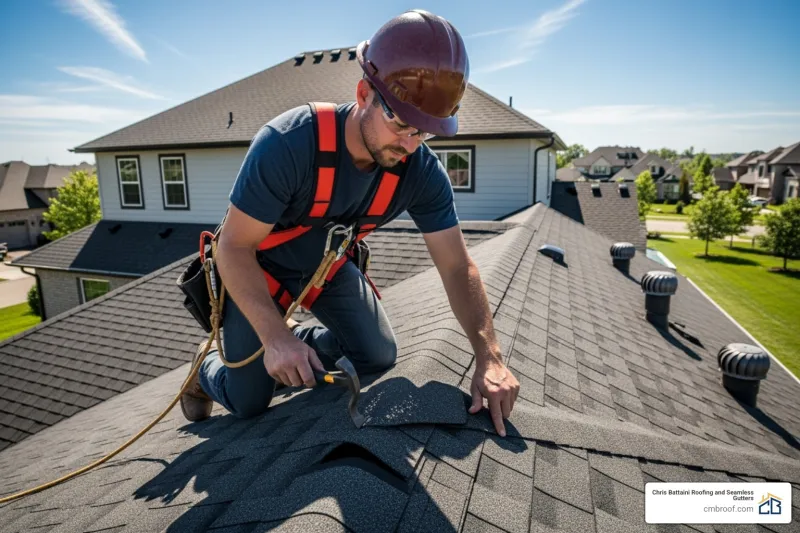
Once safely on the roof, a systematic inspector works in a pattern rather than wandering. The core activities include:
Shingle evaluation. Pressing gently with a flat tool to detect brittleness, lifting sample edges to check sealant strips, and looking for granule loss that exposes the asphalt matrix beneath.
Flashing inspection. Chimneys, plumbing vents, skylights, and valley intersections receive individual attention. On older Niagara homes, step flashing around a brick chimney is frequently the true source of a leak blamed on the shingles themselves.
Drainage checks. Gutters are examined for slope, secure fastening, and blockage. Some inspectors flush a downspout with water to confirm it actually discharges where intended.
Fastener and penetration review. Exposed nails, improperly seated boots, and antenna or satellite mounts all get logged as potential entry points.
The Attic: Half the Diagnosis Happens Underneath
An assessment that skips the attic is an incomplete one. Inside, the inspector looks for daylight penetrating the roof deck, water staining on sheathing and rafters, compressed or damp insulation, mould odours, and — critically — ventilation performance.
Niagara's humid summers and freeze-thaw winters make attic ventilation a decisive factor in roof longevity. Condensation on nail heads in January, or frost on the underside of the deck, tells an experienced inspector more about the roof's future than any exterior observation.
The Red Flags: When an Assessment Isn't Really an Assessment
Be cautious if you encounter any of the following:
- A quote produced on the driveway before the inspector has entered the attic
- Pressure tactics — "this price is only good today"
- Vagueness about what specifically is failing and why
- No photographs, no written findings, no mention of ventilation or flashing
- An inspector who never actually climbed the roof or entered the attic
A legitimate assessment educates you. A predatory one frightens you.
The Written Report: What Separates Professionals from Pitchmen
The deliverable matters as much as the inspection. Expect a document that includes photographs of each flagged issue, an explanation of cause rather than just symptom, a clear distinction between urgent repairs and items worth monitoring, and a costed recommendation that separates necessary work from optional upgrades.
Crucially, a trustworthy report sometimes recommends no action at all. A roof with eight to ten years of serviceable life left should be described as such — not positioned as an emergency.
Comparing One Assessment to Another
If you gather two or three assessments, compare them on specificity, documentation quality, and whether the recommendations align with what you observed during the walkthrough itself. Contractors who explain their reasoning in plain language, photograph their evidence, and put everything in writing are demonstrating exactly how they'll behave once the contract is signed.
An assessment is, in essence, a preview of the working relationship. On a St. Catharines roof — buffeted by lake-effect snow, summer humidity, and the occasional hail event — that relationship is worth choosing carefully.